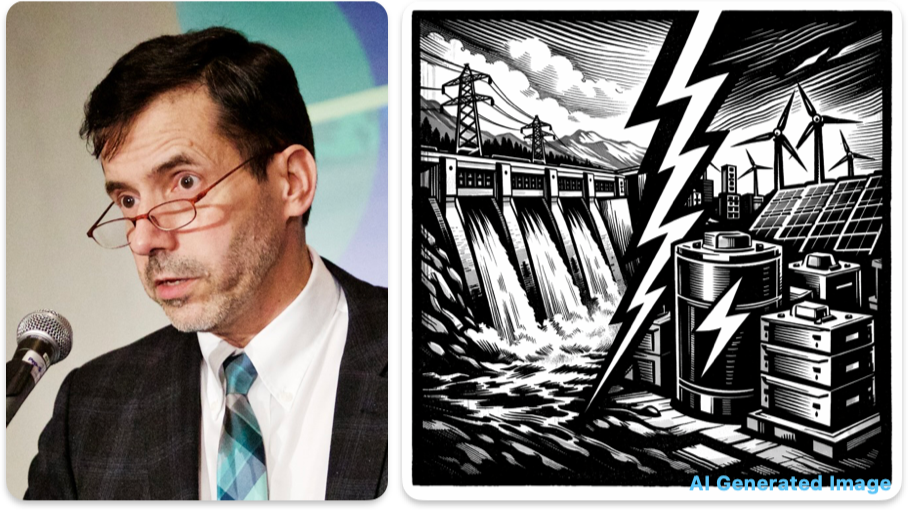
As early as 2020, Premier François Legault described Québec as the “green battery of Northeastern America”, referring to Hydro-Québec’s large reservoirs.
It is a powerful image. And for a long time, it was an accurate one.
It captured a simple reality: Hydro Québec could store energy, wait for the right moments, and sell when prices rose.
But that image belongs to a world in which flexibility was scarce.
That world is changing.
With batteries being deployed rapidly across the U.S. grid, one question now arises:
What if that battery were being short-circuited?
Not electrically. Economically.
(LinkedIn: https://www.linkedin.com/pulse/battery-northeast-being-short-circuited-benoit-marcoux-8slae)
The real model, in 2025
To understand the risk, we need to start with the numbers.
In 2025, Hydro-Québec:
- exported 11.8 TWh at 14.5¢/kWh, or about C$1.7 billion in revenue;
- imported 15.2 TWh at 7.6¢/kWh, or about C$1.15 billion in costs.
So it imported more than it exported.
And yet, it still made money.
On the order of C$500 million to C$600 million on those transactions.
That is the central point.
Hydro-Québec does not make its money by exporting a lot. It makes its money by exporting at the right time.
What that means
Hydro-Québec is not just an exporter.
It is an arbitrage player.
Its model is simple:
- buy when prices are low;
- sell when prices are high;
- capture the spread.
That is where the profit comes from.
Not from volume. From timing.
What batteries change
A recent Canary Media article on New England shows that battery deployment has entered a new phase: projects in the hundreds of megawatts are now moving ahead, with 175 MW and 250 MW facilities already online, and a 700 MWproject in development.
This is no longer marginal. These are system-shaping assets.
Most importantly, these batteries target exactly the same value Hydro-Québec has been capturing:
- they charge when prices are low;
- they sell when prices are high;
- they operate during peak hours, when the value is highest.
In other words, they do not complement Hydro-Québec’s model. They compete with it directly.
Their business model also relies on market arbitrage, supported by public policy and by a favourable environment of high prices and growing demand.
These batteries do exactly what Hydro-Québec does, but locally, in the Northeast states.
The core of the model is under attack
Let us restate the equation:
profit ? (exports × high price) ? (imports × low price)
If batteries:
- reduce peaks;
- raise off-peak prices;
- compress spreads;
then they directly reduce profit.
What they short-circuit is not hydropower itself.
It is the price spread that made the model so valuable.
Hydro-Québec is not being replaced
Still, we should avoid the wrong conclusion.
Batteries do not replace reservoirs.
They are excellent over a few hours. Much less so over several days. Even less so across seasons.
Hydro-Québec therefore retains an essential role.
But that role is changing.
Less:
- daily arbitrage;
- frequent and predictable revenue.
More:
- value during rare events;
- long-term value tied to duration.
Conclusion
The “Battery of the Northeast” remains a useful image.
But it describes the source of value less and less well.
Batteries are not replacing Hydro-Québec. They are redefining the part of its model that used to generate returns most easily.
The challenge facing Hydro-Québec CEO Claudine Bouchard, ASC is enormous. She must lead the largest buildout in Hydro-Québec’s history at the very moment when the value once captured by the “Battery of the Northeast” is beginning to migrate toward batteries deployed locally, closer to the markets.
The shock is not physical. It is economic.
And it has already begun.
References
https://www.canarymedia.com/articles/batteries/big-grid-batteries-new-england
https://www.hydroquebec.com/data/documents-donnees/pdf/hq-rapport-annuel-2025-anglais.pdf


