Category Archives: Québec

Integrated Energy System Planning (IESP): A Framework for Québec’s Energy Transition

Summary

Integrated Energy System Planning (IESP): The Future of Québec’s Energy Transition

Québec stands at a pivotal moment in its energy evolution. With electrification accelerating, we must modernize our grid, integrate renewables, and ensure energy security. Our Integrated Energy System Planning (IESP) framework offers a roadmap to optimize resources, balance supply and demand, and build a sustainable future. Let’s shape an efficient and resilient energy system!

(LinkedIn : https://www.linkedin.com/pulse/integrated-energy-system-planning-iesp-framework-qu%25C3%25A9becs-marcoux-wc95e/)

Introduction: Québec at the Crossroads of Electrification

As the global shift toward decarbonization accelerates, Québec stands at a pivotal juncture. The province faces several challenges, including the need to modernize grid infrastructure, improve reliability, integrate growing renewable energy sources, and address increasing electricity demand in sectors such as transportation and industry.

Opportunities are equally abundant. As the most electrified jurisdiction in North America, Québec has a strong foundation in its vast hydroelectric resources and its large electrical equipment manufacturing industry. This expertise positions the province to lead in clean energy exports. However, limited interconnections with neighbouring states and provinces present a significant hurdle, constraining Québec’s ability to optimize energy trade.

Achieving a sustainable, electrified economy requires a robust and flexible planning approach that aligns energy supply, infrastructure, and emerging demands. Recognizing these dynamics, Québec’s Ministry of Economy, Innovation and Energy (Ministère de l’Économie, de l’Innovation et de l’Énergie du Québec (MEIE)) has initiated work on an Integrated Energy System Planning (IESP; in French: Plan intégré des ressources énergétiques, PGIRE). This integrated plan aims to navigate these challenges and opportunities effectively, engaging a diverse set of stakeholders to ensure its success.

This document outlines my own perspective on IESP, aiming to contribute to ongoing discussions and provide insights into best practices and strategies for its development and effective implementation. I am an independent consultant and I am not paid by the government or Hydro Québec .

What Is Integrated Energy System Planning?

Integrated Energy System Planning is a strategic framework that coordinates the development and operation of interconnected energy systems. By integrating multiple energy carriers such as electricity, natural gas, hydrogen, and thermal energy across sectors like transportation, buildings, and industry, IESP enables efficient, resilient, and sustainable energy delivery. For example, an IESP could document future electricity demand scenarios in a rapidly growing city, identify potential renewable energy sources like wind or solar farms to meet this demand, and plan the phase-out of natural gas for heating, along with the necessary transmission and distribution infrastructure upgrades. This ensures that energy supply and demand remain balanced while minimizing risks, costs, and environmental impacts, and improving reliability and resilience.

The energy transition entails greater electrification, reflecting the increasing importance of electricity in heating, transportation, and industrial processes. However, other energy sources will still be used, such as renewable natural gas and biomass for heat. Also, for the next few decades, fossil fuels will continue to be used, albeit in a diminishing way. By integrating various energy sources, technologies, and sectors, IESP ensures that the energy system evolves to meet societal, economic, and environmental goals.

IESP differs from Integrated Resource Planning (IRP), which electric utilities often use to forecast and meet electricity demand within the bulk power system. Unlike utility-focused IRPs, IESP encompasses multiple utilities and energy sources, prioritizes energy efficiency, and emphasizes comprehensive system-wide coordination. Some governments, like California, conduct statewide “IRPs” that effectively function as IESPs, which can cause confusion.

Best Practices in IESP

Integrated Energy System Planning involves a holistic and forward-looking approach to align energy supply, infrastructure, and demands. To ensure effective implementation, certain best practices must be embraced:

1. Strategic Direction

  • Clear Mandate: Policymakers outline a strategic vision supported by clear policies, targeting renewable energy goals, emission reductions, reliability, resilience, affordability, and cost efficiency.
  • Scenario Analysis: Testing multiple scenarios prepares for a range of potential developments.
  • Adaptability: Regular updates ensure the plan remains relevant amidst evolving technologies, policies, and conditions.

2. Inclusive Collaboration

  • Stakeholder Engagement: Broad participation reflects societal priorities, fosters trust, and ensures accountability.
  • Interdisciplinary Approach: Cross-sector collaboration prevents siloed planning and promotes integrated solutions.

3. Robust Foundations

  • Data-Driven Decisions: Accurate forecasting models ensure informed and reliable decision-making, particularly in terms of the economic impacts of the scenarios.
  • Funding and Resources: Adequate financial investments support infrastructure development and innovation.
  • Enforcement and Oversight: Continuous monitoring ensures adherence to the plan and addresses emerging challenges.

By following these practices, IESP can create a sustainable, resilient, and inclusive energy system that adapts to future needs. For instance, Denmark has successfully implemented elements of integrated planning by combining wind energy with district heating systems, resulting in increased energy efficiency and reduced emissions. As Québec embarks on its IESP journey, these principles serve as essential guidelines to navigate the complexities of the energy transition and achieve long-term success.

Key Stakeholders in IESP

Integrated Energy System Planning succeeds when diverse stakeholders collaborate effectively. Key contributors include government and regulatory bodies, utilities, grid operators, equipment manufacturers, knowledge and innovation leaders, local communities, and advocacy groups. This collective effort ensures that expertise from various domains shapes a resilient and inclusive energy system.

Government and Regulatory Bodies:

  • Provincial (state) departments, like the MEIE in Québec, oversee and regulate the planning process.
  • Energy regulators, such as utility commissions or energy boards (Régie de l’énergie in Québec), ensure compliance and accountability.

Utilities and Grid Operators:

  • Utilities, like Hydro-Québec and Energir, handle energy generation, transmission, and distribution.
  • Independent System Operators (ISOs) and Regional Transmission Organizations (RTOs), when they exists, manage the grid and technical feasibility where applicable. Note: there is no independent operator in Québec.

Knowledge and Innovation Contributors:

  • Academic and research institutions offer expertise, data analysis, and innovative solutions. The Hydro-Québec research centre (IREQ) could contribute, especially if it integrates better into Quebec’s industrial fabric.
  • Private sector experts, such as engineering and business consulting firms, provide knowledge in renewable energy, energy storage, advanced technologies, regulations, and experiences from other jurisdictions.
  • Equipment manufacturers provide indispensable expertise in the design, production, and optimization of the components needed to build and maintain energy systems, ensuring a robust and adaptive supply chain.

Local and Community Stakeholders:

  • Local governments and municipalities address city-specific energy needs and integration efforts.
  • Indigenous communities advocate for rights, priorities, and land use considerations.
  • General public and community groups reflect societal values and secure buy-in for proposed changes.
  • Non-Governmental Organizations (NGOs), including industry and business associations, offer diverse perspectives, often championing sustainability, equity, and innovative solutions that can help bridge gaps between communities, governments, and industries.

Responsibility for IESP Development and Monitoring

The development and oversight of an IESP should be managed by an independent entity equipped with technical expertise, impartiality, and strong stakeholder engagement capabilities.

In Québec, this role has been taken on by the MEIE. Generally, government ministries are well suited to lead IESP initiatives due to their independence, broad stakeholder representation, and authority to address large-scale energy needs. However, they often require technical and operational support from engineering or strategy consulting firms.

Other potential entities to oversee IESP include:

  • Energy Regulators: These bodies ensure compliance and accountability through independent oversight. However, their focus on regulation might limit leadership in strategic planning.
  • Independent System Operators (ISOs) or Regional Transmission Organizations (RTOs): These organizations have strong technical knowledge and operational expertise but are limited by their focus on electricity grids, excluding other energy sources.
  • Utilities: Utilities may lead planning provided they have sufficient coverage across energy sectors. In Québec, however, no single utility dominates both electricity and natural gas markets, making collaborative leadership or support from government entities essential. Ensuring independence of utilities also remains a challenge, particularly for investor-owned utilities.
  • Collaborative Consortia: Partnerships that include government, utilities, academia, and private sector experts can balance expertise and leadership but require clear governance to maintain focus and authority.

Outputs and Timeline

The primary output of an IESP is a comprehensive energy system roadmap. This roadmap must:

  • Account for Diverse Energy Sources: Incorporate electricity, renewable natural gas, hydrogen, biomass, and fossil fuels (in transition) while outlining strategies for integrating new energy technologies and phasing out unsustainable sources.
  • Meet Community Needs: Address the unique energy demands and priorities of various communities, including affordability, accessibility, and cultural considerations, particularly for Indigenous communities and underserved regions.
  • Establish a Long-Term Vision: Provide demand forecasts, resource plans, and investment strategies that align with climate goals, such as reducing greenhouse gas emissions and increasing energy efficiency.
  • Detailed Implementation Steps: Offer policy recommendations, infrastructure upgrade strategies, funding strategies, and specific milestones with timelines to ensure smooth execution.

This approach ensures a balanced, inclusive, and future-ready energy system. The IESP process typically spans 18 to 36 months, depending on scope and complexity. Energy system roadmaps are periodically revised to stay relevant and adapt to changing conditions. Updates integrate new technologies, market shifts, policy changes, and unexpected challenges. Fast-evolving areas like renewable integration or grid resilience may need annual monitoring. Transparent reporting builds public trust and accountability.

Geographic Scope

Integrated Energy System Planning can be implemented at different geographic levels, each offering unique advantages and challenges:

City-Level IESP

  • Focus: Tailored to address local energy demands and urban challenges, such as electrifying transportation or district heating.
  • Advantages: Provides customized solutions with strong community engagement and simplified governance.
  • Challenges: Limited impact on broader regional systems.
  • Example: Vancouver’s Renewable City Strategy (RCS) is a comprehensive plan designed to transition the city to 100% renewable energy by 2050 across all sectors, including buildings, transportation, and energy systems. See https://vancouver.ca/files/cov/renewable-city-strategy-booklet-2015.pdf.

Regional, Provincial, or State-Level IESP

National-Level IESP

  • Focus: Oversees large-scale energy transitions, aligning national policy with climate goals and energy security.
  • Advantages: Ensures consistency in policies and leverages economies of scale.
  • Challenges: May miss regional nuances and specific community needs.
  • Example 1: Denmark’s energy strategy integrates wind energy and district heating on a national scale. This roadmap has been revised multiple times since its inception in the 1970s. See https://www.irena.org/-/media/Files/IRENA/Agency/Publication/2013/GWEC/GWEC_Denmark.pdf.
  • Example 2: Great Britain’s Clean Power 2030 (CP2030) programme aims to ensure that the country can meet its energy needs primarily from renewable sources by 2030. This includes the massive expansion of offshore wind, solar, and battery storage capacity, as well as extending the life of existing nuclear power plants. The programme includes an estimated annual investment of £40 billion, as well as the construction of 1,000 km of power lines and 4,500 km of submarine cables. It should be noted that wind power production in Great Britain is mainly in the North, while energy demand is higher in the South, a situation like that of Québec. See https://www.neso.energy/publications/clean-power-2030.

Continental or Multi-Country IESP

The Importance of Execution

The success of an IESP depends heavily on its execution. A meticulously designed plan will fall short without a clear pathway to implementation, robust oversight, and ongoing adaptability. Key elements of successful execution include:

  • Alignment with Priorities: Energy regulators and other stakeholders must ensure the investments align with the priorities set forth in the IESP roadmap. Stranded assets and misaligned projects can cause opposition, waste resources, and delay goals.
  • Flexible and Adaptive Management: As technologies, markets, and policies evolve, the energy system must remain flexible. Regular updates to the IESP and the continuous incorporation of new data will allow stakeholders to respond effectively to emerging challenges and opportunities.
  • Technological Integration: Leveraging emerging technologies that drive the energy transition—such as energy storage, electric vehicles, wind and solar generation, AI, advanced analytics, demand response, and real-time monitoring systems—is essential. For utilities and independent power producers, these tools enable more accurate demand and renewable generation forecasting, optimize hydroelectric and other generation systems, improve grid balancing, and facilitate early identification of potential failures. From the perspective of energy users, AI can revolutionize energy management by optimizing heating, cooling, EV charging, local energy storage, and lighting in real time based on occupancy and usage patterns. For industrial plants, smart solutions can minimize energy costs and identify opportunities to shift toward cleaner energy resources like electricity as a heat source. These innovations empower both utilities and energy consumers to collaborate in achieving enhanced sustainability, cost effectiveness, and energy resilience.
  • Stakeholder Coordination: Effective execution requires seamless collaboration among federal and provincial (state) governments, cities, utilities and independent power producers, commercial and industrial energy users, the electricity supply chain, existing fossil fuel industry players, and community groups. Clear communication channels and well-defined roles are essential to ensure alignment and prevent missteps. This collaborative and inclusive approach ensures that all stakeholders contribute to a resilient and efficient energy transition.
  • Public Trust and Transparency: Transparent reporting on progress fosters public trust and secures long-term support. For instance, Denmark’s transparent communication regarding its wind energy projects has significantly increased public buy-in, helping to accelerate renewable energy adoption and achieve ambitious climate goals. Stakeholders must actively engage with communities to maintain accountability and ensure inclusivity.
  • Infrastructure Investments: Adequate and timely investment in critical infrastructure—such as grid upgrades, renewable energy integration, and energy storage systems—is essential. These investments must be planned to handle future growth and extreme weather events.

Risks of Failure

The risks that could lead to ineffective IESP execution include:

  • Growth Challenges: North American electric utilities, which have experienced limited growth since 2000, must adapt and scale operations by a factor of perhaps 3 or 4 by 2050 (but much less in Québec given its already high electrification level) to meet the demands of increasing electrification. This transformation demands the electricity supply chain—encompassing manufacturers, professional service providers, and infrastructure developers—to scale as well. Addressing this monumental operational, financial, and logistical challenge will require innovative strategies, substantial investments, and comprehensive stakeholder coordination.
  • Reliability and Resilience: As utilities transition into becoming the primary energy delivery system within the economy, they must enhance reliability (minimizing outages) and resilience (ensuring robust recovery and adaptability, particularly during extreme weather events).
  • Inflexibility: Rigid adherence to outdated plans can lead to inefficiency and missed opportunities.
  • Underinvestment: Insufficient funding for infrastructure development risks blackouts, bottlenecks, and public backlash.
  • Stakeholder Fragmentation: Lack of coordination among key players undermines progress and wastes resources.
  • Delayed Action: Hesitation in adapting to changing conditions exacerbates existing challenges, pushing back timelines for achieving goals.

By proactively addressing these risks and prioritizing execution excellence, Québec can ensure that its IESP delivers on its promise of a resilient and sustainable energy future.

Recommendations for Québec

  1. Establish an Independent Planning Body: Consider an independent energy planning agency for Québec, modelled after entities like Ontario’s Independent Electricity System Operator (IESO).
  2. Foster Stakeholder Engagement: Promoting the involvement of municipalities, Indigenous communities, and private sector actors can enrich the planning process by incorporating diverse perspectives and expertise.
  3. Leverage Existing Strengths: Build on Hydro-Québec’s expertise in hydroelectricity and transmission grid management and on the large electricity supply chain in Québec.
  4. Focus on Resilience: Prioritize infrastructure upgrades to accommodate electrification and extreme weather events.
  5. Set Clear Metrics: Define performance indicators to track progress and adapt plans as necessary.

Conclusion

Integrated Energy System Planning offers Québec a roadmap to a sustainable, electrified future, fostering energy resilience, economic growth, and environmental stewardship. By embracing best practices, addressing execution challenges, and aligning efforts with provincial strengths, Québec can position itself as a global leader in the energy transition.

From Counter-Reformation to America First: How Isolationism Threatens Innovation and Progress

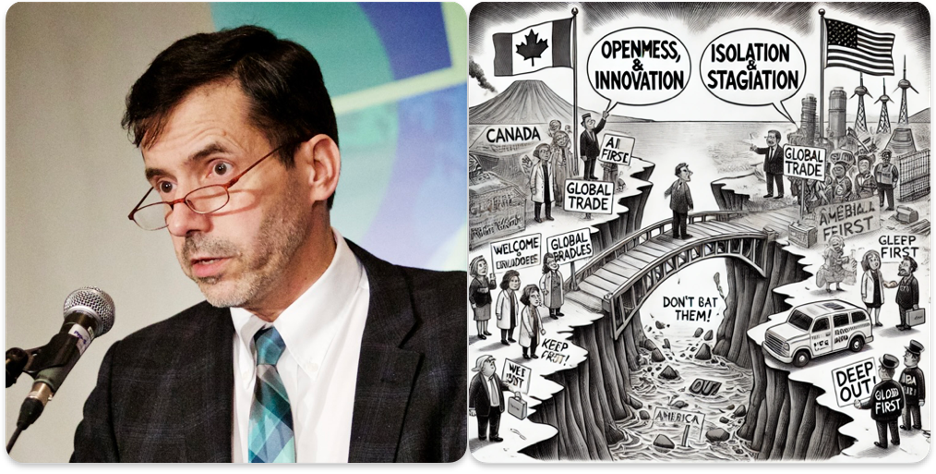
Summary: History shows that isolation leads to stagnation, while openness fosters innovation. The Counter-Reformation of the 16th and 17th centuries stifled Catholic Europe’s progress, just as Trump’s policies on immigration, trade, and fossil fuels threaten U.S. leadership today. Canada, however, stands to benefit—attracting talent, investment, and advancing AI and green tech.

(LinkedIn: https://www.linkedin.com/pulse/from-counter-reformation-america-first-how-threatens-progress-benoit-6jh7e)

Introduction

History consistently demonstrates that societies embracing openness, intellectual freedom, and collaboration thrive, while those turning inward risk stagnation. The Counter-Reformation of the 16th and 17th centuries saw Catholic Europe suppress dissent and restrict scientific progress, while Protestant nations fostered innovation and flourished. Today, the United States, under President Trump’s second term, is undergoing a similar inward turn—characterized by restrictive immigration policies, trade barriers (especially with Canada), and a renewed focus on fossil fuels. While some institutions resist this shift, these policies could weaken U.S. leadership in science, technology, and economic growth. Meanwhile, this crisis presents a unique opportunity for more open societies, such as Canada, to attract talent, investment, and technological leadership.


The Counter-Reformation and the Suppression of Scientific Innovation

The Counter-Reformation was the Catholic Church’s response to the Protestant Reformation, which originated in the Netherlands before spreading throughout Europe. In a bid to maintain control, the Church enforced strict censorship, persecuted dissenting intellectuals, and prioritized religious orthodoxy over free inquiry. As a result, once-prominent Catholic nations like Spain and Italy saw a decline in scientific contributions due to the rigid restrictions imposed by institutions like the Inquisition.

In contrast, Protestant nations such as the Netherlands and England embraced intellectual openness, paving the way for groundbreaking discoveries. Thinkers such as Johannes Kepler, Isaac Newton, and Robert Boyle flourished in these societies, pushing humanity forward in science, philosophy, and technology. The Counter-Reformation also slowed advancements in medicine by restricting human dissection and anatomical research, limiting medical knowledge in Catholic regions. Additionally, Catholic authorities censored and restricted the dissemination of scientific texts, hampering the spread of new ideas. The development of navigation, which relied on astronomical observations, was also affected by the resistance to heliocentric theories, delaying progress in exploration.

This divergence between Catholic and Protestant regions serves as a historical case study of how intellectual repression leads to stagnation, while openness fosters progress.

This historical lens is crucial in understanding the United States’ current trajectory under isolationist policies.


Trump’s Isolationism: Immigration and Trade Policies Closing Off the U.S.

Just as the Counter-Reformation stifled intellectual and economic advancement in Catholic Europe, President Trump’s policies in immigration and trade risk pushing the U.S. toward economic and technological insularity.

Immigration: The Loss of Global Talent

The U.S. has long been a magnet for the world’s brightest minds, fuelling its leadership in science, technology, and entrepreneurship. However, Trump’s immigration policies threaten this historic advantage:

  • Tightened Restrictions on High-Skilled Immigration: Increased visa backlogs, reduced work visa availability, and bureaucratic hurdles discourage top-tier professionals, redirecting them toward Canada and Europe.
  • Declining University Enrollment: A significant drop in international student applications weakens research institutions, which rely on foreign talent to maintain global competitiveness.

Although mass deportations primarily impact undocumented immigrants rather than high-skilled professionals, the broader anti-immigration stance deters global talent from considering the U.S. as an innovation hub. Much like how the Counter-Reformation drove intellectuals to Protestant regions, Trump’s immigration policies risk pushing top scientists, engineers, and entrepreneurs to more open societies. Countries like Canada, with proactive immigration policies, stand to benefit from this exodus of talent.

Trade: Economic Retrenchment and Damage to U.S.-Canada Relations

Trump’s economic nationalism mirrors the economic isolationism of Catholic Europe, which saw its global influence decline as Protestant nations expanded their trade networks.

  • Tariffs on Canada and Mexico: A 25% tariff on imports from Canada (10% on energy) and Mexico disrupts long-standing trade relationships and increases costs for consumers and businesses.
  • Weakening of the USMCA: While the United States-Mexico-Canada Agreement (USMCA) was intended to modernize NAFTA, recent tariff impositions undermine its stability and will trigger retaliatory measures.
  • “Buy American” Policies: These policies discourage supply chain integration with allies, making U.S. manufacturing less competitive globally.

Canada has responded by announcing 25% counter-tariffs on American goods, while leveraging its position as a major supplier of critical minerals—potentially shifting trade relationships toward Europe and Asia. As the U.S. isolates itself, Canada has a unique opportunity to expand its role in global trade networks and attract foreign investment.


Green and Climate Technologies: Losing Ground in the Race for the Future

Just as the Counter-Reformation rejected scientific advancements such as Galileo’s heliocentric model and medical discoveries, Trump’s rollback of forward-looking policies threatens U.S. leadership in emerging green technologies.

  • Return to Fossil Fuels: The administration has prioritized coal, oil, and natural gas over renewable energy, even as the rest of the world accelerates investment in clean energy.
  • Regulatory Rollbacks: Federal emissions regulations have been weakened, funding for renewable energy research slashed, and participation in international climate agreements reduced.
  • Global Competition: While the U.S. turns back to fossil fuels, China and, to a lesser extent, the European Union are dominating the global green energy sector, leading in electric vehicles, battery storage, hydrogen energy, and solar and wind power manufacturing.

The long-term risk is clear: if the U.S. continues to retreat from green innovation, it will lose its technological edge in industries that will define the future global economy—just as Catholic Europe lost its scientific edge to Protestant nations. However, Canada, with its commitment to renewable energy and environmental policies, has the potential to position itself as a leader in the transition to a green economy.


Institutional Resistance: Countering the Inward Turn

Despite Trump’s restrictive policies, several key institutions have resisted the U.S.’s inward shift, helping to preserve its role as an international leader in innovation and trade.

  • State Governments: Many states, particularly California, have maintained strong environmental and trade policies, signing independent agreements with global partners.
  • Tech and Business Leaders: Companies like Apple and Microsoft continue investing in international talent and supply chains, resisting protectionist policies.
  • Universities and Research Institutions: Top universities remain hubs for international collaboration, advocating for the continued influx of global talent.
  • International Partnerships: Canada and the EU can deepen ties with U.S. states and companies, ensuring that American innovation remains linked to global markets.

As these institutions push back against isolationist policies, they create openings for global strategic partnerships. This resistance highlights the possibility of maintaining and even strengthening economic and technological collaborations beyond the U.S. borders. Canada, in particular, stands to benefit by aligning with these forward-thinking entities, setting the stage for broader economic expansion and leadership in key industries.


Canada’s Opportunity for Economic Development

As the U.S. withdraws from global leadership in clean technology, trade, and green innovation, Canada can capitalize on this shift by taking proactive steps to drive economic growth:

  • Expanding Talent and Research Leadership: Canada can strengthen its position as a global innovation hub by expanding pathways for skilled workers, researchers, and entrepreneurs. Montréal and Toronto have become international AI powerhouses, attracting top-tier talent and investment in cutting-edge technology.
  • Strengthening Trade Networks and Supply Chains: By deepening economic ties with Europe, Asia, and other global partners, Canada can reduce reliance on the U.S. market. Strategic investments in critical supply chains—such as electrical equipment, battery technology, and artificial intelligence—will ensure long-term competitiveness in the evolving global economy.
  • Investing in Clean and Advanced Technologies: Increased government support for renewable energy, electric vehicle production, and sustainable infrastructure can position Canada as a leader in future industries. Building on AI-driven advancements, these sectors can drive sustainable economic growth and innovation.
  • Boosting Domestic Manufacturing and High-Value Industries: Strengthening Canada’s domestic manufacturing capabilities will help secure its role in high-value industries, ensuring economic resilience and positioning the country as a key player in the new global economy.

By embracing these opportunities, Canada can transform this crisis into a catalyst for long-term economic expansion, solidifying its role as a leader in trade, technology, and sustainability.


Conclusion: The Cost of Closing Off and the Opportunity for Others

Just as the Counter-Reformation stifled Catholic Europe’s intellectual and economic progress while Protestant nations thrived, Trump’s isolationist policies—particularly in immigration, trade, and emerging technologies—risk undermining U.S. leadership. However, institutional resistance within the U.S. suggests that, unlike Catholic Europe of the 16th and 17th centuries, the country may quickly recover from this inward turn if more open policies are reinstated in the future. Meanwhile, Canada and other open societies stand to gain from the U.S.’s retreat, attracting top talent, investment, and leadership in the industries of the future.

De la Contre-Réforme à l’Amérique d’abord : comment l’isolationnisme menace l’innovation et le progrès

Résumé : L’histoire montre que l’isolement mène à la stagnation tandis que l’ouverture favorise l’innovation. La Contre-Réforme des XVIe et XVIIe siècles a étouffé les progrès de l’Europe catholique, tout comme les politiques de Trump sur l’immigration, le commerce et les combustibles fossiles menacent aujourd’hui le leadership américain. Le Canada a toutefois tout à gagner en attirant des talents, des investissements et en faisant progresser l’IA et les technologies vertes.

(LinkedIn: https://www.linkedin.com/pulse/de-la-contre-r%25C3%25A9forme-%25C3%25A0-lam%25C3%25A9rique-dabord-comment-menace-benoit-marcoux-buele)

Introduction

L’histoire démontre constamment que les sociétés qui adoptent l’ouverture, la liberté intellectuelle et la collaboration prospèrent, tandis que celles qui se replient sur elles-mêmes risquent la stagnation. La Contre-Réforme des XVIe et XVIIe siècles a vu l’Europe catholique réprimer la dissidence et restreindre le progrès scientifique, tandis que les nations protestantes ont encouragé l’innovation et prospéré. Aujourd’hui, les États-Unis, sous le deuxième mandat du président Trump, connaissent un repli sur soi similaire, caractérisé par des politiques d’immigration restrictives, des barrières commerciales (en particulier avec le Canada) et un regain d’intérêt pour les combustibles fossiles. Bien que certaines institutions résistent à ce changement, ces politiques pourraient affaiblir le leadership des États-Unis dans les domaines de la science, de la technologie et de la croissance économique. Entre-temps, cette crise offre une occasion unique aux sociétés plus ouvertes, comme le Canada, d’attirer des talents, des investissements et un leadership technologique.


La contre-réforme et la suppression de l’innovation scientifique

La Contre-Réforme était la réponse de l’Église catholique à la Réforme protestante, qui a pris naissance aux Pays-Bas avant de se répandre dans toute l’Europe. Dans le but de maintenir le contrôle, l’Église a imposé une censure stricte, persécuté les intellectuels dissidents et donné la priorité à l’orthodoxie religieuse plutôt qu’à la libre enquête. En conséquence, des nations catholiques autrefois importantes, comme l’Espagne et l’Italie, ont connu une baisse des contributions scientifiques en raison des restrictions rigides imposées par des institutions comme l’Inquisition.

En revanche, les nations protestantes, telles que les Pays-Bas et l’Angleterre, ont adopté l’ouverture intellectuelle, ouvrant la voie à des découvertes révolutionnaires. Des penseurs, tels que Johannes Kepler, Isaac Newton et Robert Boyle, ont prospéré dans ces sociétés, poussant l’humanité vers l’avant dans la science, la philosophie et la technologie. La Contre-Réforme a aussi ralenti les progrès de la médecine en limitant la dissection humaine et la recherche anatomique. Cela a limité les connaissances médicales dans les régions catholiques. De plus, les autorités catholiques ont censuré et restreint la diffusion de textes scientifiques, ce qui a entravé la diffusion de nouvelles idées. Le développement de la navigation, qui dépendait d’observations astronomiques, a aussi été freiné par la résistance aux théories héliocentriques, ce qui a entravé les progrès de l’exploration.

Cette divergence entre les régions catholiques et protestantes sert d’étude de cas historique sur la façon dont la répression intellectuelle conduit à la stagnation, tandis que l’ouverture favorise le progrès.

Cette lentille historique est cruciale pour comprendre la trajectoire actuelle des États-Unis dans le cadre de politiques isolationnistes.


Isolationnisme de Trump : les politiques d’immigration et de commerce ferment les États-Unis

Tout comme la Contre-Réforme a étouffé le progrès intellectuel et économique dans l’Europe catholique, les politiques du président Trump en matière d’immigration et de commerce risquent de pousser les États-Unis vers l’insularité économique et technologique.

L’immigration : la perte de talents mondiaux

Les États-Unis ont longtemps été un aimant pour les esprits les plus brillants du monde, alimentant leur leadership dans les sciences, la technologie et l’entrepreneuriat. Cependant, les politiques d’immigration de Trump menacent cet avantage historique :

· Restrictions renforcées sur l’immigration hautement qualifiée : L’augmentation des arriérés de visas, la réduction de la disponibilité des visas de travail et les obstacles bureaucratiques découragent les professionnels de haut niveau, les redirigeant vers le Canada et l’Europe.

· Baisse des inscriptions à l’université : Une baisse significative des demandes d’étudiants internationaux affaiblit les établissements de recherche, qui comptent sur les talents étrangers pour maintenir la compétitivité mondiale.

Bien que les expulsions massives touchent principalement les immigrants sans papiers plutôt que les professionnels hautement qualifiés, la position anti-immigration plus large dissuade les talents mondiaux de considérer les États-Unis comme un centre d’innovation. Tout comme la façon dont la Contre-Réforme a conduit les intellectuels dans les régions protestantes, les politiques d’immigration de Trump risquent de pousser les meilleurs scientifiques, ingénieurs et entrepreneurs vers des sociétés plus ouvertes. Des pays comme le Canada, dotés de politiques d’immigration proactives, profiteront de cet exode de talents.

Commerce : Compressions économiques et dommages aux relations entre les États-Unis et le Canada

Le nationalisme économique de Trump reflète l’isolationnisme économique de l’Europe catholique, qui a vu son influence mondiale décliner à mesure que les nations protestantes élargissant leurs réseaux commerciaux.

· Droits de douane sur le Canada et le Mexique : Un droit de douane de 25 % sur les importations en provenance du Canada (10 % sur l’énergie) et du Mexique perturbe les relations commerciales de longue date et augmente les coûts pour les consommateurs et les entreprises.

· Affaiblissement de l’AEUMC : Alors que l’Accord États-Unis-Mexique-Canada (AEUMC) visait à moderniser l’ALENA, les récentes impositions de droits de douane minent sa stabilité et déclencheront des mesures de rétorsion.

· Politiques «?Buy American?» : Ces politiques découragent l’intégration de la chaîne d’approvisionnement avec leurs alliés, ce qui rend le secteur manufacturier américain moins compétitif à l’échelle mondiale.

Le Canada a réagi en annonçant des contre-droits de douane de 25 % sur des produits américains, tout en tirant parti de sa position en tant que fournisseur important de minéraux essentiels, ce qui pourrait modifier les relations commerciales vers l’Europe et l’Asie. Alors que les États-Unis s’isolent, le Canada a une occasion unique d’élargir son rôle dans les réseaux commerciaux mondiaux et d’attirer les investissements étrangers.


Technologies vertes et climatiques : perdre du terrain dans la course à l’avenir

Tout comme la Contre-Réforme a rejeté les progrès scientifiques, tels que le modèle héliocentrique de Galilée et les découvertes médicales, le recul de Trump des politiques tournées vers l’avenir menace le leadership des États-Unis dans les technologies vertes émergentes.

· Retour aux combustibles fossiles : L’administration a donné la priorité au charbon, au pétrole et au gaz naturel plutôt qu’aux énergies renouvelables, alors même que le reste du monde accélère les investissements dans l’énergie propre.

· Reculs réglementaires : Les règlements fédéraux sur les émissions ont été affaiblis, le financement de la recherche sur les énergies renouvelables a été réduit et la participation aux accords internationaux sur le climat a diminué.

· Concurrence mondiale : Alors que les États-Unis reviennent aux combustibles fossiles, la Chine et, dans une moindre mesure, l’Union européenne dominent le secteur mondial de l’énergie verte, en tête dans les secteurs des véhicules électriques, du stockage de batteries, de l’énergie hydrogène et de la fabrication d’énergie solaire et éolienne.

Le risque à long terme est clair : si les États-Unis continuent de se retirer de l’innovation verte, ils perdront leur avantage technologique dans les industries qui définiront la future économie mondiale, tout comme l’Europe catholique a perdu son avantage scientifique au profit des nations protestantes. Cependant, le Canada, grâce à son engagement à l’égard des énergies renouvelables et des politiques environnementales, a le potentiel de se positionner comme un chef de file dans la transition vers une économie verte.


Résistance institutionnelle : contrer le virage vers l’intérieur

Malgré les politiques restrictives de Trump, plusieurs institutions clés ont résisté au repli d’intérieur des États-Unis, aidant à préserver leur rôle de leader international en matière d’innovation et de commerce.

· Gouvernements des États : De nombreux États, en particulier la Californie, ont maintenu des politiques environnementales et commerciales solides, signant des accords indépendants avec des partenaires mondiaux.

· Leaders technologiques et commerciaux : Des entreprises comme Apple et Microsoft continuent d’investir dans les talents et les chaînes d’approvisionnement internationaux, résistant aux politiques protectionnistes.

· Universités et instituts de recherche : Les meilleures universités demeurent des plaques tournantes de la collaboration internationale, plaidant pour l’afflux continu de talents mondiaux.

· Collaborations internationales : Le Canada et l’Union européenne peuvent renforcer leurs liens avec les États-Unis et les entreprises, s’assurant que l’innovation américaine reste ancrée sur les marchés mondiaux.

Alors que ces institutions s’opposent aux politiques isolationnistes, elles créent des ouvertures pour des partenariats stratégiques mondiaux. Cette résistance met en évidence la possibilité de maintenir et même de renforcer les collaborations économiques et technologiques au-delà des frontières américaines. Le Canada, en particulier, a tout à gagner à s’aligner sur ces entités avant-gardistes, préparant ainsi le terrain pour une expansion économique et un leadership plus larges dans des industries clés.


Les possibilités de développement économique du Canada

Alors que les États-Unis se retirent du leadership mondial en matière de technologie propres, de commerce et d’innovation verte, le Canada peut tirer parti de ce changement en prenant des mesures proactives pour stimuler la croissance économique :

· Accroître le talent et le leadership en recherche : Le Canada peut renforcer sa position en tant que centre d’innovation mondial en élargissant les voies pour les travailleurs qualifiés, les chercheurs et les entrepreneurs. Montréal et Toronto, en particulier, sont devenues des puissances internationales de l’IA, attirant des talents de haut niveau et des investissements dans la technologie de pointe.

· Renforcement des réseaux commerciaux et des chaînes d’approvisionnement : En approfondissant les liens économiques avec l’Europe, l’Asie et d’autres partenaires mondiaux, le Canada peut réduire sa dépendance à l’égard du marché américain. Les investissements stratégiques dans les chaînes d’approvisionnement essentielles, comme l’équipement électrique, la technologie des batteries et l’intelligence artificielle, assureront la compétitivité à long terme de l’économie mondiale en évolution.

· Investir dans les technologies propres et de pointe : Un soutien gouvernemental accru à l’énergie renouvelable, à la production de véhicules électriques et à l’infrastructure durable peut positionner le Canada comme un chef de file dans les industries futures. En s’appuyant sur les progrès réalisés par l’IA, ces secteurs peuvent stimuler une croissance économique et une innovation durables.

· Stimuler la fabrication nationale et les industries de grande valeur : Le renforcement des capacités de fabrication nationales du Canada aidera à renforcer son rôle dans les industries de grande valeur, à assurer la résilience économique et à positionner le pays comme un acteur clé de la nouvelle économie mondiale.

En saisissant ces possibilités, le Canada peut transformer cette crise en un catalyseur d’expansion économique à long terme, renforçant ainsi son rôle de chef de file en matière de commerce, de technologie et de durabilité.


Conclusion : Le coût de la fermeture et l’occasion pour les autres

Tout comme la Contre-Réforme a étouffé le progrès intellectuel et économique de l’Europe catholique tandis que les nations protestantes prospéraient, les politiques isolationnistes de Trump — en particulier dans l’immigration, le commerce et les technologies émergentes — risquent de saper le leadership américain. Cependant, la résistance institutionnelle au sein des États-Unis suggère que, contrairement à l’Europe catholique XVIe et XVIIe siècles, le pays pourrait rapidement se remettre de ce virage intérieur si des politiques plus ouvertes sont rétablies à l’avenir. Pendant ce temps, le Canada et d’autres sociétés ouvertes ont tout à gagner du recul des États-Unis, attirant les meilleurs talents, les investissements et le leadership dans les industries de l’avenir.

Navigating “America First”: Strategic Focus for Canada’s Energy Transition

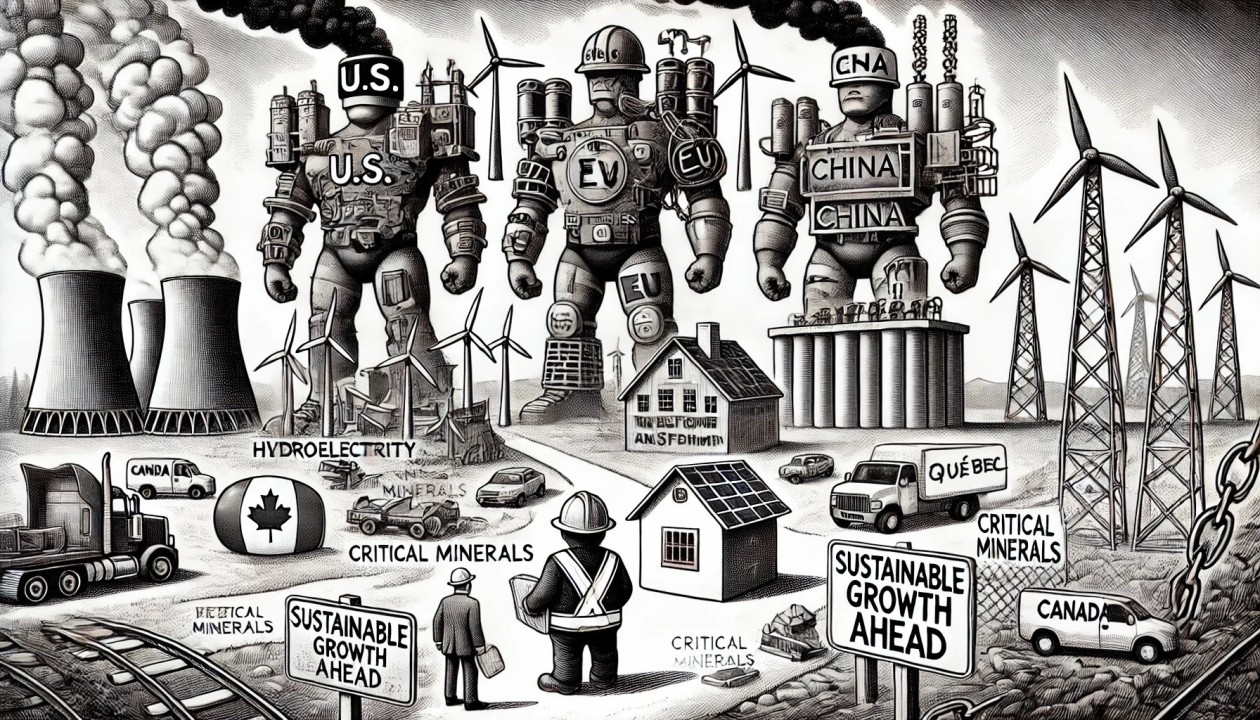
The “America First” trade policy and executive orders recently signed by President Trump present significant challenges for Canada’s energy sector, particularly for Québec. These measures include proposed tariffs on Canadian goods, a divergence in climate policies, and the rollback of electric vehicle (EV) incentives in the U.S. Given the deep integration of the North American auto and energy sectors, these developments have far-reaching implications for Canada’s energy transition.

(LinkedIn: https://www.linkedin.com/pulse/navigating-america-first-strategic-focus-canadas-energy-marcoux-vxmnc/)

Key Challenges

1. Tariffs and Market Competitiveness

The U.S. has proposed a 25% tariff on Canadian goods, including energy exports like oil, natural gas, and hydroelectricity. Québec’s hydroelectric sector, which relies heavily on electricity exports to the U.S., would be directly affected. Such tariffs would undermine Hydro Québec’s competitiveness for long-term contracts and its ability to trade on short-term spot markets in the U.S. Northeast. Canadian oil, already trading at a discount, would face further price pressure, exacerbating financial challenges for oil-producing provinces. This situation also raises questions about the viability of the Keystone XL pipeline, which was promoted by President Trump but may be rendered unnecessary if tariffs further reduce the competitiveness of Canadian oil. This contradiction adds to the uncertainty of future energy investments.

2. Reduced EV Availability

The rollback of U.S. EV incentives and infrastructure programs could hinder the growth of Canada’s EV supply chain. The integration of the North American auto sector means U.S. policies directly influence Canadian markets. A decrease in EV availability in the U.S. could similarly limit their availability in Canada, hindering the adoption of clean transportation technologies and delaying progress toward national emissions reduction targets.

3. Trade Restrictions and Supply Chain Risks

Potential U.S. trade restrictions on imports from countries like China or export controls on critical technologies could delay Canada’s energy transition. Key technologies at risk include:

  • Artificial Intelligence (AI): Vital for optimizing energy systems, enabling smart grids, and improving energy efficiency across sectors.
  • Energy storage systems: Batteries are essential for renewable energy integration, ensuring grid stability and balancing supply and demand. Advanced systems like lithium-ion and solid-state technologies play a critical role in renewable energy adoption and electric vehicles.
  • Grid management software: Necessary for modernizing energy infrastructure.
  • Solar and wind components: Turbines, panels, and related systems.
  • Transmission and distribution grid equipment: Critical for efficient electricity transmission and grid reliability, particularly with the integration of renewable energy. Transformers are currently in short supply, while DC transmission systems (HVDC) are an expanding market.

If Canada mirrors U.S. restrictions, it could face higher costs and limited access to these critical technologies.

Strategic Responses

Strengthening Domestic Supply Chains

Canada has a much smaller economy than the U.S., the EU, or China. It cannot realistically build supply chains for all components of the energy sector. Governments must focus on critical segments or areas where Canada has a competitive advantage. Key strategies include:

  • Re-shoring Manufacturing: Establishing domestic production for segments such as EV batteries, wind turbine components, and transformers to reduce reliance on foreign imports.
  • Trade Diversification: Expanding partnerships with Europe, South Korea, and Japan to secure access to essential materials and technologies.
  • Critical Material Access: Investing in domestic mining and recycling of rare earth elements and other vital materials.
  • Public-Private Partnerships: Supporting innovation and local manufacturing through subsidies and targeted investments.

Examples of focus areas include:

  • Critical Minerals: Leveraging Canada’s abundant reserves of lithium, nickel, and cobalt to support battery manufacturing.
  • Hydroelectric Power and Energy Storage: Capitalizing on Québec’s hydroelectric capacity, with east-west integration, and integrating advanced energy storage systems.
  • Renewable Hydrogen Production: Using renewable energy to produce green hydrogen for industrial decarbonization, particularly in sectors like steel and chemicals.

Prioritizing Local Energy Use

Québec’s abundant hydroelectric resources present an opportunity to focus on local decarbonization rather than exports. Electrification of transportation, heating, and heavy industry within Québec could reduce emissions while insulating the province from volatile export markets.

Similarly, while Canada’s oil and gas sectors warrant support in the near term, governments must balance investments against long-term trends. The International Energy Agency (IEA) predicts a global decline in oil and gas demand as economies transition to net-zero emissions, and China’s consumption of oil likely peaked in 2024. Resources should be prioritized for decarbonization initiatives and the development of clean energy technologies to build long-term economic resilience and adaptability.

Conclusion

The challenges posed by the “America First” trade policy highlight the importance of strategic focus for Canada’s energy transition. By investing in resilient supply chains, emphasizing local energy use, and targeting key sectors where Canada has competitive advantages—such as hydroelectricity, critical minerals, and renewable hydrogen—Canada and Québec can strengthen their energy sectors, enhance economic resilience, and accelerate the transition to a sustainable energy future.

Naviguer dans «?America First?» : un axe stratégique pour la transition énergétique du Canada

La politique «?America First?» et les décrets signés récemment par le président Trump posent des défis importants au secteur énergétique du Canada, particulièrement au Québec. Ces mesures incluent des tarifs proposés sur les biens canadiens, une divergence dans les politiques climatiques et un recul des incitatifs pour les véhicules électriques (VE) aux États-Unis. Compte tenu de l’intégration profonde des secteurs nord-américains de l’automobile et de l’énergie, ces développements ont des implications importantes pour la transition énergétique du Canada.

(LinkedIn: https://www.linkedin.com/pulse/naviguer-dans-america-first-un-axe-strat%C3%A9gique-pour-la-benoit-marcoux-yiefc)

Défis principaux

1. Tarifs et compétitivité du marché

Les États-Unis ont proposé un tarif de 25 % sur les biens canadiens, y compris les exportations d’énergie, comme le pétrole, le gaz naturel et l’hydroélectricité. Le secteur hydroélectrique du Québec, qui dépend fortement des exportations d’électricité vers les États-Unis, serait directement touché. De tels tarifs affaibliraient la compétitivité d’Hydro Québec pour les contrats à long terme et sa capacité à échanger sur les marchés spot à court terme dans le nord-est des États-Unis. Le pétrole canadien, qui se négocie déjà à prix réduit, subirait une pression supplémentaire sur les prix, aggravant les défis financiers des provinces productrices de pétrole. Cette situation soulève aussi des questions sur la viabilité de l’oléoduc Keystone XL, promu par le président Trump, mais qui pourrait devenir inutile si les tarifs réduisent davantage la compétitivité du pétrole canadien. Cette contradiction ajoute à l’incertitude des futurs investissements énergétiques.

2. Réduction de la disponibilité des VE

Le recul des incitatifs et des programmes d’infrastructure pour les VE aux États-Unis pourrait freiner la croissance de la chaîne d’approvisionnement des VE au Canada. L’intégration du secteur automobile nord-américain signifie que les politiques américaines influencent directement les marchés canadiens. Une diminution de la disponibilité des VE aux États-Unis pourrait également limiter leur disponibilité au Canada, freinant l’adoption des technologies de transport propre et retardant les progrès vers les objectifs nationaux de réduction des émissions.

3. Restrictions commerciales et risques pour les chaînes d’approvisionnement

Les restrictions commerciales potentielles des États-Unis sur les importations de pays comme la Chine ou les contrôles à l’exportation sur les technologies critiques pourraient retarder la transition énergétique du Canada. Les technologies clés en danger incluent :

  • Intelligence artificielle (IA) : Essentielle pour optimiser les systèmes énergétiques, permettre des réseaux intelligents et améliorer l’efficacité énergétique dans tous les secteurs.
  • Systèmes de stockage d’énergie : Les batteries sont indispensables pour l’intégration des énergies renouvelables, garantissant la stabilité du réseau et équilibrant l’offre et la demande. Les systèmes avancés, tels que les batteries au lithium-ion et à l’état solide, jouent un rôle crucial dans l’adoption des énergies renouvelables et des véhicules électriques.
  • Logiciels de gestion des réseaux : Nécessaires pour moderniser les infrastructures énergétiques.
  • Composants solaires et éoliens : Turbines, panneaux et systèmes connexes.
  • Équipements de transmission et de distribution : Essentiels pour la transmission efficace de l’électricité et la fiabilité du réseau, en particulier avec l’intégration des énergies renouvelables. Les transformateurs sont actuellement en pénurie, tandis que les systèmes de transmission en courant continu (HVDC) représentent un marché en expansion.

Si le Canada suit les restrictions américaines, il pourrait faire face à des coûts plus élevés et à un accès limité à ces technologies critiques.

Réponses stratégiques

Renforcer les chaînes d’approvisionnement nationales

Le Canada dispose d’une économie bien plus petite que celles des États-Unis, de l’UE ou de la Chine. Il ne peut pas raisonnablement construire des chaînes d’approvisionnement pour tous les composants du secteur énergétique. Les gouvernements doivent se concentrer sur les segments critiques ou les domaines où le Canada a un avantage concurrentiel. Les stratégies clés incluent :

  • Relocalisation de la fabrication : Établir une production nationale pour des segments tels que les batteries pour VE, les composants d’éoliennes et les transformateurs afin de réduire la dépendance aux importations étrangères.
  • Diversification commerciale : Élargir les partenariats avec l’Europe, la Corée du Sud et le Japon pour sécuriser l’accès aux matériaux et technologies essentiels.
  • Accès aux matériaux critiques : Investir dans l’exploitation minière nationale et le recyclage des terres rares et d’autres matériaux vitaux.
  • Partenariats public-privé : Soutenir l’innovation et la fabrication locale grâce à des subventions et des investissements ciblés.

Exemples de domaines prioritaires :

  • Minéraux critiques : Tirer parti des abondantes réserves de lithium, de nickel et de cobalt du Canada pour soutenir la fabrication de batteries.
  • Hydroélectricité et stockage d’énergie : Capitaliser sur la capacité hydroélectrique du Québec, avec intégration est-ouest, et intégrer des systèmes de stockage d’énergie avancés.
  • Production d’hydrogène renouvelable : Utiliser les énergies renouvelables pour produire de l’hydrogène vert destiné à la décarbonisation industrielle, en particulier dans des secteurs comme l’acier et la chimie.

Prioriser l’utilisation locale de l’énergie

Les abondantes ressources hydroélectriques du Québec offrent une opportunité de se concentrer sur la décarbonisation locale plutôt que sur les exportations. L’électrification des transports, du chauffage et des industries lourdes au Québec pourrait réduire les émissions tout en isolant la province des marchés d’exportation volatils.

De même, bien que les secteurs pétroliers et gaziers du Canada méritent un soutien à court terme, les gouvernements doivent équilibrer les investissements face aux tendances à long terme. L’Agence internationale de l’énergie (AIE) prévoit un déclin mondial de la demande de pétrole et de gaz à mesure que les économies passent à des émissions nettes nulles, et la consommation de pétrole de la Chine a probablement atteint son pic en 2024. Les ressources devraient être priorisées pour les initiatives de décarbonisation et le développement de technologies d’énergie propre afin de renforcer la résilience économique et l’adaptabilité à long terme.

Conclusion

Les défis posés par la politique «?America First?» soulignent l’importance d’une approche stratégique pour la transition énergétique du Canada. En misant sur des chaînes d’approvisionnement robustes, en favorisant une utilisation accrue de l’énergie produite localement et en se concentrant sur des secteurs clés où le Canada détient un avantage compétitif, comme l’hydroélectricité, les minéraux critiques et l’hydrogène vert, le Canada et le Québec peuvent renforcer leur secteur énergétique, améliorer leur résilience économique et accélérer la transition vers un avenir énergétique respectueux de l’environnement.

Les entreprises de services écoénergétiques sont des acteurs clés, mais méconnus, de la transition énergétique. Que font-elles??

Une entreprise de services écoénergétiques (communément appelée ESÉ, ou «?Energy Service Company?», ESCo, en anglais) est une entreprise qui développe, installe et organise le financement de projets visant à optimiser l’efficacité énergétique, la gestion de pointe, et les coûts des installations énergétiques d’entreprises et d’institutions.

Généralement, les ESÉ peuvent offrir les services suivants :
– Diagnostiquer la consommation énergétique et l’état des systèmes.
– Élaborer et organiser le financement de projets d’efficacité énergétique.
– Installer et entretenir l’équipement.
– Mesurer et vérifier les économies d’énergie.
– Opérer les systèmes de gestion de pointe.
– Valider les factures du distributeur d’électricité et du détaillant.

Les principaux leviers techniques sont l’immotique, l’éclairage, le chauffage et la climatisation des locaux, ainsi que le chauffage de l’eau.

Les grandes ESÉ prennent à leur compte certains risques techniques et de performance associés au projet par un contrat de performance énergétique (CPE) qui finance les améliorations à même les économies futures, sur plusieurs années.

Au Québec, les contrats de performance se sont développés rapidement à partir de 1998, après des modifications réglementaires touchant les appels d’offres des organismes publics. Dans la province, les deux principales ESÉ sont Ecosystem et Énergère. Econoler, l’une des premières ESÉ au monde, fut fondée en 1981 par Hydro Québec et Dessau-Soprin, un bureau de génie-conseil. Les dirigeants d’Ecololer ont racheté l’entreprise par la suite.

Ailleurs au Canada, les principales ESÉ sont Ainsworth Inc, Ameresco, Honeywell, Johnson Controls, Siemens et Trane, mais d’autres y sont aussi actives, et l’approche des contrats de performance y est moins développée.

En règle générale, les clients des ESÉ bénéficient de l’expertise d’un spécialiste qui les guide et les défend dans leurs interactions contractuelles et techniques avec les ESÉ. Ce spécialiste les aide à évaluer les économies d’énergie, à les calculer et à les mesurer chaque année, ainsi qu’à mettre en place des mécanismes de compensation en cas de succès ou d’échec dans l’atteinte de ces économies.

On trouve également plusieurs joueurs spécialisés qui ne sont pas des ESÉ à proprement parler, ne proposant que quelques services. Certains s’appuient sur l’intelligence artificielle, comme BrainBox AI et vadiMAP. Des firmes d’ingénierie sont également présentes sur le marché, principalement dans la conception et l’élaboration. De plus, de grandes entreprises européennes comme Engie ont récemment fait leur entrée sur le marché.

Energy service companies are important but little-known players in the energy transition. What do they do?

An energy service company, commonly referred to as an ESCo, specializes in enhancing energy efficiency, managing energy peaks, and reducing energy expenses for businesses and organizations.

Generally, ESCos may offer the following services:
– Diagnose energy consumption and system status.
– Develop and organize the financing of energy efficiency projects.
– Install and maintain equipment.
– Measure and verify energy savings.
– Operate state-of-the-art management systems.
– Validate invoices from the electricity distributor and the retailer.

The main technical levers are building automation, lighting, space heating and air conditioning, and water heating.

Large ESCos take on some of the technical and performance risks associated with the project by funding improvements through an Energy Performance Contract (EPC), which is funded from future energy savings over several years.

In the Québec market, performance contracts developed strongly after 1998, following regulatory changes applicable to calls for tenders by public bodies. In the province, the two main ESCos are Ecosystem and Énergère. Econoler, one of the first ESCos in the world, was founded in 1981 by Hydro Québec and Dessau-Soprin, a consulting engineering firm. Ecololer’s managers later bought the company.

Elsewhere in Canada, the major ESCos are Ainsworth Inc, Ameresco, Honeywell, Johnson Controls, Siemens and Trane, but others are also active in these countries, and the performance contracting approach is less developed.

Typically, ESCo customers have an expert who guides and advocates for them in their interactions with the ESCos, specifically in regards to contractual and technical matters. This expert’s role is to help evaluate energy savings, determine how to calculate and quantify them annually, and negotiate compensation arrangements between the parties if the desired savings are not met.

There are also several niche players, not necessarily ESCos, that provide limited services, some of which utilize artificial intelligence, such as BrainBox AI and vadiMAP. Engineering firms are also active in the market, particularly in the design and development stages. We are also seeing the emergence of large European companies like Engie.

Photo of Benoit Marcoux

likecelebratesupportloveinsightfulfunnyLikeCommen

Comment la chaîne de valeur de l’électricité au Québec se compare au reste du monde

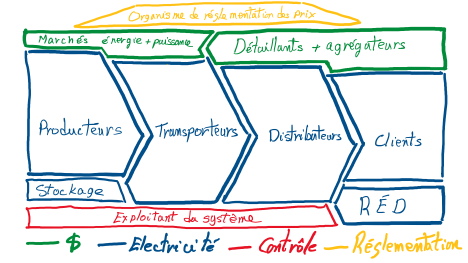
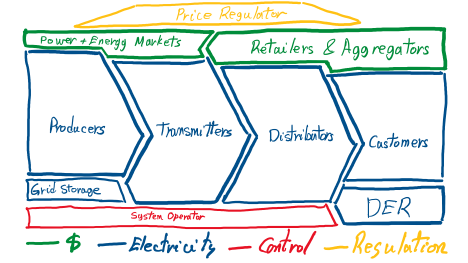
Dotée d’une hydroélectricité abondante, la chaîne de valeur de l’électricité du Québec s’est développée à sa façon. À titre de comparaison, la figure ci-dessous illustre les rôles communs des différents acteurs qui fournissent de l’électricité dans le monde.

En Europe, au Royaume-Uni, dans la plupart des États-Unis et en Ontario et en Alberta, des acteurs discrets remplissent chacune des cases du diagramme. Plus particulièrement, les producteurs vendent de l’électricité sur les marchés de l’énergie, achetée par des détaillants indépendants pour la revendre aux clients finaux. Les détaillants ne vendent que de l’énergie et ils ne sont pas propriétaires du réseau reliant les producteurs aux clients. Les détaillants peuvent être des entreprises privées concurrentielles ou des organismes publics sans but lucratif, selon les régions. Le flux d’électricité des producteurs aux clients est contrôlé par un opérateur de système indépendant. Les réseaux de transport et de distribution, qui sont des goulots, sont réglementés sur le prix, souvent avec des incitations à la fiabilité et aux coûts. Mais, dans l’ensemble, c’est la même chose que vous (le client) ayant un accès Internet filaire d’une société de téléphone ou de câblodistribution (c.-à-d. le réseau) pour ensuite acheter des services multimédias vendus par Netflix ou Apple (c.-à-d. les producteurs).

Au Québec, Hydro Québec est le producteur, le transporteur et le distributeur dominants. Elle a son propre opérateur de système interne et utilise des appels d’offres et des contrats gré à gré, et non un marché, pour acheter auprès de certains producteurs d’électricité indépendants. La vente au détail d’électricité est fournie avec la distribution d’électricité et il n’y a pas d’agrégateurs pour la gestion des pointes. Il y a très peu de stockage sur le réseau (autre que les vastes réservoirs) et peu de ressources énergétiques distribuées (RÉD). L’organisme de réglementation provincial n’approuve plus les dépenses du service public et les prix de l’électricité, maintenant rattachés à l’indice des prix à la consommation, jusqu’à concurrence de 3 %.

Le dégroupement de la chaîne de valeur de l’électricité du Québec, en partie ou autant qu’en Europe, ne peut se faire sans évaluer les avantages et les inconvénients de cette approche. Cependant, nous devons certainement regarder comment d’autres ont fait face à la rareté d’électricité alors que nous nous prélassions dans l’abondance. Parce que, après tout, il y aura plus de rareté que d’abondance à l’avenir.

How Québec’s Electricity Value Chain Compares to the World

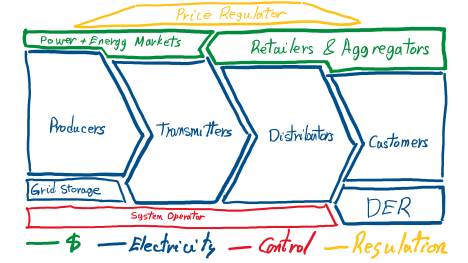
Endowed with abundant hydropower, Québec’s electricity value chain developed in its own way. For comparison, the figure below illustrates the common roles of the various players delivering electricity to the world.

In Europe, the UK, most of the US and in Ontario and Alberta, discrete actors fill each of the boxes in the diagram. Most notably, producers sell electricity on energy markets, bought by independent retailers for resale to end customers. Retailers only sell energy and they do not own the grid connecting producers to customers. Retailers can either be competitive private ventures or not-for-profit public agencies, depending on regions. The flow of electricity from producers to customers is controlled by an independent system operator. The transmission and distribution grids, which are bottleneck facilities, are regulated on price, often with reliability and cost incentives. But, overall, this is the same as you (the customer) having a wired Internet access from a phone or cable company (aka the grid) and then buying media services sold by Netflix or Apple (aka producers).

In Québec, Hydro Québec is the dominant producer, transmitter, and distributor. It has its own internal system operator and uses tenders and negotiated contracts, not a market, to buy from some independent power producers. Electricity retail is bundled with electricity distribution and there are no aggregators for peak management. There is very little grid storage (other than the vast reservoirs) and few Distributed Energy Resources (DER). The provincial regulator no longer approves spending by the utility and the electricity prices, now pegged to the consumer price index, up to 3%.

Unbundling Québec’s electricity value chain, partly or as much as it is in Europe, cannot be done without assessing the pros and cons of this approach. However, we certainly need to look how others have coped with electricity scarcity while we basked in abundance. Because, after all, there will be more scarcity than abundance in the future.

The Impact of Industrial Policies on Québec’s Electricity Industry

With the energy transition, Québec is currently at a turning point reminiscent of the period following the Quiet Revolution, in the 1960s and 1970s, when successive Unionist, Liberal and PQ governments initiated the development of the Manic-Outardes project, which doubled Québec’s electricity generation capacity, and then Churchill Falls (Labrador) and James Bay, which doubled it again. Today, there is again talk of doubling by 2050. But increasing Hydro Québec’s generation capacity was not the only highlight of the 1960s and 1970s.

In the 1960s and 1970s, governments also used the construction of major hydro plants to enable French-speaking Quebecers to take control of the province’s economic development. This economic development occurred both in the secondary sector (electrical equipment manufacturing and aluminum smelters) and in the tertiary sector (large consulting engineering firms and, a little later, in information technology).

We can still hear the echoes of this decision because there are about 65,000 jobs related to the electricity industry, only a third of which are at Hydro-Québec.

Québec is now Canada’s electrical manufacturing hub: we have 36.3% of Canadian electrical manufacturing jobs, but only 22.7% of total Canadian manufacturing jobs. In other words, we have proportionally twice as many jobs in electrical equipment manufacturing as Canada outside Québec. This includes the manufacture of electrical power generation and systems, as well as appliances used by residential and commercial customers, such as heaters and advanced control systems.

Obviously, the impact of these industrial policies on the aluminum smelting industry is well known: it has experienced considerable growth, with 30,000 jobs.

And that’s not all: this period also saw the emergence of world-class Québec consulting engineering firms, some of which reached the top-10 in the world, such as SNC-Lavalin (AtkinsRéalis). Our consulting engineering firms are present throughout the value chain, from large dams to residential energy efficiency assessments.

In the 1970s, the industry’s need for control and management systems propelled the information technology sector — CGI, LGS, an IBM Company and DMR come to mind. In a way, it’s safe to say that even the artificial intelligence sector that Québec is now known for was driven by the electrification decisions made by our grandparents.

L’impact des politiques industrielles dans l’industrie de l’électricité au Québec.

Avec la transition énergétique, le Québec se trouve actuellement à un tournant qui rappelle la période qui a suivi la Révolution tranquille, dans les années 60 et 70, alors que les gouvernements successifs, unionistes, libéraux ou péquistes, ont alors enclenché le développement des grands ouvrages de Manic-Outardes, qui ont doublé la capacité de production du Québec, de Churchill Falls (au Labrador) et de la Baie-James, qui l’ont encore doublé. Aujourd’hui, on parle à nouveau de doubler à l’horizon 2050. Mais augmenter la capacité de production d’Hydro Québec ne fut pas le seul point marquant des années 60 et 70.

Dans les années 60 et 70, les gouvernements ont aussi utilisé la construction des grands ouvrages pour permettre aux Québécois francophones de prendre en main le développement économique de la province. Ce développement économique fut à la fois dans le secteur secondaire (fabrication d’équipement électrique et alumineries) et dans le secteur tertiaire (grandes firmes de génie-conseil et, un peu plus tard, en technologies de l’information).

On entend encore les échos de cette décision d’avenir, car il y a environ 65?000 emplois liés à l’industrie de l’électricité, dont un tiers seulement à Hydro-Québec.

Le Québec est aujourd’hui le pôle canadien de fabrication de matériel électrique : nous avons 36,3 % des emplois canadiens de fabrication de matériel électrique, mais seulement 22,7 % des emplois manufacturiers totaux canadiens. Dits autrement, nous avons proportionnellement 2 fois plus d’emplois en fabrication de matériel électrique que le Canada hors Québec. On parle ici de fabrication d’appareils de production et de réseaux électriques, mais aussi d’appareils utilisés chez les clients résidentiels et commerciaux, comme les appareils de chauffage et les systèmes de contrôle de la pointe.
Évidemment, l’impact de ces politiques industrielles sur l’industrie de la transformation de l’aluminium est bien connu : elle a connu un essor considérable, avec 30?000 emplois.

Ce n’est pas tout : cette période a aussi vu l’émergence de firmes québécoises de génie-conseil de calibre international dont certaines sont parvenues au top-10 mondial, comme SNC-Lavalin (AtkinsRéalis). Nos firmes de génie-conseil sont présentes tout au long de la chaîne de valeur, des grands barrages jusqu’aux évaluations d’efficacité énergétique des résidences.

Dans les années 70, les besoins de systèmes de contrôle et de gestion du secteur ont propulsé le secteur des technologies de l’information — on pense à CGI, LGS, an IBM Company et DMR. D’une certaine façon, on peut dire que mêmele secteur de l’intelligence artificielle qui fait maintenant la renommée du Québec a été poussé par les décisions d’électrification prises par nos grands-parents.

Community Choice Aggregation : une alternative pour l’avenir de l’électricité au Québec??

Avec Hydro-Québec, le Québec est doté de ressources naturelles incomparables, dont un potentiel hydroélectrique et un réseau d’électricité uniques. Son système électrique est également hautement intégré, de la production aux clients. 

D’autres régions, confrontées à des choix énergétiques plus difficiles, ont adopté des structures industrielles différentes. Je veux ici explorer une tendance forte aux États-Unis et voir comment nous pourrions nous en inspirer : Community Choice Aggregation. 

Les agrégateurs communautaires (Community Choice Aggregators ou CCA) sont des organismes publics sans but lucratif qui ont une certaine exclusivité de vente au détail de l’électricité dans une région. Les CCA permettent aux administrations locales (villes et comtés) de se procurer de l’énergie au nom de leurs résidents, de leurs entreprises et de leurs municipalités tout en recevant des services de transport et de distribution de leur compagnie d’électricité locale. En agrégeant la demande, les collectivités obtiennent un effet de levier pour négocier de meilleurs tarifs avec des fournisseurs concurrentiels et choisir des sources d’énergie plus vertes. Étant locales, les CCA peuvent également être mieux placées pour offrir des services et des programmes d’efficacité énergétique adaptés à leurs collectivités. 

Il y a plus de 1200 CCA aux États-Unis desservant 10,6 millions de clients dans 8 états. En 2022, environ 100 térawattheures (TWh) d’électricité ont été achetés par les CCA. Les collectivités qui participent aux programmes de CCA négocient leur source de production d’énergie, utilisent le pouvoir d’achat en vrac pour réduire les coûts de l’énergie, stimulent le développement des ressources locales d’énergie renouvelable et des emplois locaux dans l’énergie propre, assurent la stabilité et la transparence des prix de l’énergie, tout en accélérant la transition vers l’énergie renouvelable avec chaque initiative. Les CCA travaillent en partenariat avec le service public existant de la région. Le CCA achète l’électricité, et le service public continue de la livrer, d’entretenir le réseau et de fournir une facturation consolidée.

Est-ce que cela pourrait être adapté au Québec?? Peut-être, pourquoi pas?? Je ne dis pas que c’est la solution, mais c’est peut-être un outil auquel il faut réfléchir.

Je suis cette tendance depuis quelques années maintenant, alors contactez-moi si vous voulez en discuter. 

Community Choice Aggregation: An Alternative for Québec’s Electricity Future?

With Hydro-Québec, Québec is endowed with incomparable natural resources, including unique hydroelectricity potential and electricity system. Its electricity system is also highly integrated, from generation to customers. 

Other regions, facing more difficult energy choices, adopted different industry structures. I want here to explore a strong trend in the US and see how we could be inspired by it: Community Choice Aggregation (CCA). 

Community Choice Aggregators (CCA) are not-for-profit public agencies having some electricity retail exclusivity in an area. CCAs allow local governments (cities and counties) to procure energy on behalf of their residents, businesses, and municipalities while still receiving transmission and distribution service from their local utility provider. By aggregating demand, communities gain leverage to negotiate better rates with competitive suppliers and choose greener power sources. Being local, CCAs may also be better positioned to offer services and energy efficiency programs tailored to their communities. 

There are over 1200 CCAs in the US serving 10.6 million customers across 8 states. In 2022, approximately 100 terawatt-hours (TWh) of electricity was procured by CCA communities. Communities that participate in CCA programs negotiate their source of energy generation, use bulk buying power to decrease energy costs, spur the development of local renewable energy resources and local clean energy jobs, ensure energy price stability and transparency, while accelerating the transition to renewable energy with every initiative. CCAs work in partnership with the region’s existing utility. The CCA buys the power, and the utility continues to deliver it, maintain the grid, and provide consolidated billing.

Could this be adapted to Québec? Perhaps, why not? I’m not saying that this is the solution, but it may be a tool to think about.

I have been following this trend for a few years now, so reach out to me if you want to discuss. 

Clear Definitions for Energizing Discussions

In the debate surrounding the upcoming Hydro-Québec bill, many opinions are circulating. Unfortunately, several concepts are mixed up, which confuses the discussion. Here are some definitions to enlighten readers.

  • Monopoly: The transmission and the distribution of electricity are natural monopolies. This means that there is “naturally” a single supplier that emerges in each location (or corridor for transmission). Imagine if several suppliers wanted to have poles along our streets! It doesn’t happen. However, there are already 11 electricity distributors with a monopoly in Québec: Hydro-Québec, 9 cities and a cooperative. Hydro-Québec is not the only distributor. For transmission, some companies have lines, such as Rio Tinto, and some lines have been built in partnership. Once again, Hydro-Québec is not alone.
  • Monopoly (bis): The production of electricity and the retail sale of electricity are not natural monopolies. In several regions, such as the European Union, several producers compete and sell electricity on an open market. Electricity retailers buy and sell this energy to consumers proposing various plans, much like we see in the telecommunications industry. Electricity is delivered from producers to consumers using the natural monopoly of transmission and distribution companies. This 4-stage structure (production-transmission-distribution-retail) is common, and Québec’s vertically integrated structure is more the exception than the rule.
  • Price regulation: Monopoly means price regulation. Transmission and distribution prices are always regulated to ensure a fair return on prudent investments; sometimes performance incentives (reliability, costs) are imposed, as in Great Britain or Alberta. Where production and retail are competitive, regulation can be light, mainly to ensure that prices and conditions of service are fair, and to ensure that competition works for the benefit of consumers. Also, it should be noted that prices must be regulated even for a state monopoly.
  • Nationalization (or privatization): The nationalization of electricity production and delivery in Québec, a legacy of the Quiet Revolution, is not seriously questioned: no one will want to sell Hydro-Québec, as Hydro One was in Ontario a few years ago. The nationalization of private electricity companies has made it possible to accelerate electrification (helping the trade balance), to develop the industrial sector of Québec’s economy (electrical equipment and aluminum), and to develop the service sector (consulting engineering and computer science). However, nationalization does not mean that the private sector has no role to play or that Hydro-Québec should be the sole producer. 

Beyond words, the important thing is to set the right goals and use the levers at our disposal to achieve them, understanding the advantages and disadvantages of each model. 

Des définitions claires pour une discussion énergisante

Dans le débat entourant le projet de loi à venir sur Hydro-Québec, beaucoup d’opinions circulent. Malheureusement, on y mélange plusieurs concepts, ce qui embrouille la discussion. Voici donc quelques définitions pour éclairer les lecteurs.

  • Monopole : Le transport et la distribution d’électricité sont des monopoles naturels. Ça veut dire qu’il y a «?naturellement?» un seul fournisseur qui émerge dans chaque endroit (ou corridor pour le transport). Imaginez si plusieurs fournisseurs voulaient avoir des poteaux le long de nos rues?! Ça ne se fait pas. Cependant, il y a déjà au Québec 11 distributeurs d’électricité avec un monopole : Hydro-Québec, 9 villes et une coopérative. Hydro-Québec n’est donc pas le seul distributeur. Pour le transport, certaines entreprises ont des lignes, comme Rio Tinto, et certaines lignes ont été construites en partenariat, comme avec les Mohawks vers les États-Unis. Encore ici, Hydro-Québec n’est pas seule.
  • Monopole (bis) : La production d’électricité et la vente au détail de l’électricité ne sont pas des monopoles naturels. Dans plusieurs régions, comme dans l’Union européenne, plusieurs producteurs se concurrencent pour faire de l’électricité vendue sur un marché ouvert. Les détaillants d’électricité achètent et revendent cette énergie aux consommateurs, selon divers plans, un peu comme on le voit dans l’industrie des télécommunications. L’électricité est livrée des producteurs aux consommateurs en utilisant le monopole naturel des entreprises de transport et de distribution. Cette structure à 4 étapes (production-transport-distribution-détail) est commune, et la structure largement intégrée verticalement du Québec est plus l’exception que la règle. Cependant, il y a aussi au Québec plusieurs autres producteurs : en éolien (Boralex, Kruger, Innergex, Énergir, etc.), avec de petites centrales hydroélectriques, certaines entreprises (comme Rio Tinto), et même certaines municipalités (comme Sherbrooke).
  • Réglementation des prix : Qui dit monopole dit réglementation des prix. Les prix de transport et de distribution sont toujours réglementés pour assurer un rendement correct sans être indus, forçant des investissements prudents?; parfois, les incitatifs à la performance (fiabilité, coûts) sont imposés, comme en Grande-Bretagne ou en Alberta. Là où la production et le détail sont concurrentiels, la réglementation peut être légère, essentiellement pour s’assurer que les prix et les conditions de services sont équitables, et pour s’assurer que la concurrence fonctionne pour le bien des consommateurs. Aussi, notons que les prix doivent être réglementés même pour un monopole d’État. Au Québec, la Régie de l’énergie est responsable de la réglementation du transport, de la distribution et de la vente au détail de l’électricité.
  • Nationalisation (ou privatisation) : La nationalisation est le transfert à l’état de la propriété d’entreprises privées. La nationalisation de la production et de la livraison de l’électricité au Québec, héritage de la Révolution tranquille, n’est pas sérieusement remise en question : personne ne voudra vendre Hydro-Québec au privé, à l’exemple d’Hydro One en Ontario il y a quelques années. La nationalisation des entreprises privées d’électricité, d’abord en 1944 puis en 1963, a permis, entre autres, d’accélérer l’électrification (aidant à la balance commerciale), de développer le secteur industriel secondaire (équipement électrique et aluminium), et de développer le secteur tertiaire (génie-conseil et informatique). Cependant, la nationalisation ne veut pas dire que le privé n’a aucun rôle à jouer ni qu’Hydro-Québec est le seul producteur, transporteur, ou distributeur. 

Au-delà des mots, l’important est de fixer les bons objectifs et d’utiliser les leviers à notre disposition pour les atteindre, en comprenant bien les avantages et les inconvénients de chaque modèle. 

Book Review: “Branchée: Hydro-Québec et le futur de l’électricité” (French version; in English : “Charging Ahead: Hydro-Québec and the Future of Electricity”)

Jean-Benoit Nadeau and Julie Barlow have published this worthwhile book on Hydro-Québec. I have recently read the French version, and the English translationwill be available on October 15, 2019. I would highly recommend this book to people who need to understand what is driving Hydro-Québec. Electrical system vendors and other industry stakeholders will certainly appreciate the perspective that Branchée/Charging Aheadbrings. However, the authors largely (but not exclusively) rely on internal Hydro-Québec sources and sometimes come across as overly praising the company. Other, more critical, sources might be needed to grasp the complexities of the energy sector in Québec. 

Overall, Branchée/Charging Ahead is a very well-documented book on Hydro-Québec and current strategic directions. Fifty-three people were interviewed, including a large number of Hydro-Québec personnel, up to the CEO, Éric Martel. The book also draws on multiple third-party references and previous article published by the authors. 

Branchée/Charging Aheadstarts with a history of Hydro-Québec. The history of Hydro-Québec innovations is highlighted, with the 735 kV transmission lines being described as “Hydro-Québec’s great technical prowess”[i]. However, this technology dates back to the 1960s’. While there has been nothing remotely comparable since then, the book lists other examples of Hydro-Québec innovations, such as the LineRanger robot, Li-Ion batteries and TM4 electric motors. The book rightfully says that the “commercialization of inventions is an old fantasy of Hydro-Québec. For 30 years, all CEOs have talked about their amazing potential. But their promises have always disappointed.”[ii]TM4 is a good example given in the book: TM4 used up $500 million over 20 years, but Hydro-Québec sold 55% of it to Dana for only $260 million.[iii]

The book contains many noteworthy and hard-to-find current facts and numbers that industry professional might find valuable, such as:

  • As of early 2019, there are 716 prosumers (distributed generators) on Hydro-Québec’s network.[iv]
  • By controlling just 4 baseboard smart thermostats, Hydro-Québec can reduce the peak load of a typical household by 1 kW; Ten smart thermostats lead to a 2 kW saving.[v]
  • Hydro-Québec is running a smart home pilot project with 400 households, intending to launch a new smart home product through an unnamed subsidiary; Sowee, from Électricité de France, is given as a comparable.[vi]

The authors do not attempt to explain their paradox of innovation promises to have always failed Hydro-Québec and Hydro-Québec continuing to heavily invest in innovation. 

Toward the end, Branchée/Charging Ahead provides many insights into the thinking of Hydro-Québec senior managers, including where they see the industry going, how it is going to affect Hydro-Québec, what strategic imperatives ensue, and what Hydro-Québec needs to do. Undoubtedly, vendors could find in here material to enrich proposals and presentations. 

I found very few instances of questionable facts in the book. The Philadelphia Navy Yard microgrid is given as an example[vii], but this project has now been abandoned and is being reborn on a much smaller scale. Economically, I also disagree with the statement that Hydro-Québec is well positioned to develop hydrogen production[viii]– there is far more value in using dispatchable hydro to balance renewable resources than to produce hydrogen from electricity (which is a highly inefficient process). 

Furthermore, I believe that many customers, outside industry expert, vendors or other utilities might object to some praising characterization of Hydro-Québec, such as when the authors state that Hydro-Québec “is one of the best managed electricity grids on the continent and is admired by the largest companies in the industry”[ix]or that it has one of the most reliable grids on the continent[x]. The book would have been more balanced by giving a greater voice to those external stakeholders. Also, given the generally positive perspective that the authors are offering, Branchée/Charging Aheadwill certainly support Hydro-Québec when it tries to gather support for Bill 34[xi].  

All this being said, I greatly enjoyed reading the book and I highly recommend it to anyone wanting to better understand this fascinating company. However, I would caution against drawing conclusions or designing policies based solely on Branchée/Charging Aheadwithout balancing some of the ideas with more independent sources.   


[i]                Chapter 2. Quotes from the book are translated from the French edition. 

[ii]               Chapter 10.

[iii]              Chapter 10.

[iv]               In the introduction and later in chapters 4, 5 and 6.

[v]                Chapter 6.

[vi]               Chapter 6.

[vii]              Chapter 6.

[viii]             Chapter 6

[ix]               In the introduction.

[x]                Chapter 1.

[xi]               See https://benoit.marcoux.ca/blog/bill-34-selling-to-hydro-quebec/for my take on Bill 34.