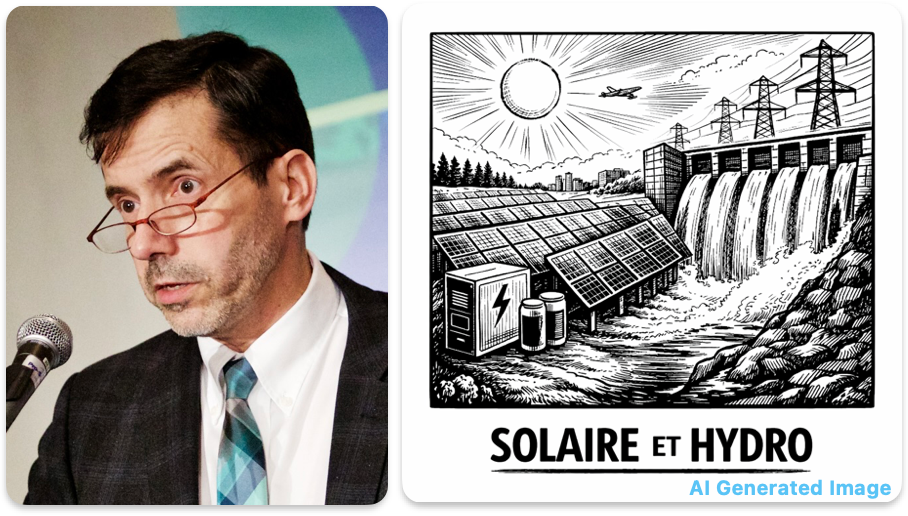
It is good to see Hydro?Québec finally supporting the expansion of solar.
Since March 31, 2026, Hydro Québec has been offering a subsidy for solar panels, with a target of 125,000 prosumers. Today, there are roughly 1,000. This signal is critical to kick-start a market.
But let’s be clear: this is catch-up.
(LinkedIn: https://www.linkedin.com/pulse/solar-qu%25C3%25A9bec-catching-up-benoit-marcoux-t6wse/)
A debate already settled elsewhere
Fifteen years ago, at Hydro One, I worked on business modelling for the smart grid transformation.
At the time:
- More than 25,000 residential and commercial PV installations were already in place.
- Utility-scale solar plants were connected directly to the distribution grid.
What Québec is now beginning to consider was already being deployed elsewhere more than a decade ago.
A Clear Global Trajectory
Solar is now the fastest-growing source of electricity worldwide. Including in regions comparable to Québec.
Take Sweden:
- Similar population.
- Further north.
- Lower level of final electrification.
By the end of 2025: ~5.4 GW of solar generation installed.
That is the same order of magnitude as what Québec projects in its integrated energy system plan (PGIRE)… for 2050.
And Sweden is still accelerating by simplifying permitting.
The message is clear: solar is not marginal. It is structural.
The Australian Example
To understand the gap, look at a market that has already gone through this phase.
Australia shares several characteristics with Canada: large territory, abundant resources, a developed economy, and a historically centralized power system.
Useful reference: GenCost 2025–26 (CSIRO).
Today, before subsidies:
- Utility scale: ~AUD 1,600/kW (~CAD 1,500/kW), going down to $ 1,000 by 2035.
- Rooftop: ~AUD 1,200/kW (~CAD 1,100/kW), approaching $ 1,000 by 2035.
Approaching $1/W, before subsidies. Surprisingly, rooftop solar is cheaper to build per kW, although annual generation (kWh/kW) is better for larger, better-optimized solar farms.
Why these costs in Australia?
- Global industrialization of modules.
- Standardization.
- Repetition.
- Installation ecosystem.
- Volume.
Solar is modular: the more you build, the simpler and cheaper it gets.
A large share of costs is local (installation, engineering, permitting). These decline with experience.
In Canada/Québec: ~1.6 to $3.0/W, with rooftop more expensive.
This is not structural.
It is an ecosystem gap.
A Misunderstood Difference
The key factor is speed.
Solar is built in weeks or months for customer installations, or a couple of years for large-scale projects. Major hydro projects take 10–15 years.
With the same technology, installation is broadly comparable across geographies, even if slowed in winter. Sunshine and climate are often cited. They are not the main issue.
The real difference:
- Australia has been building for 15 years.
- Québec is just starting.
Solar is not cheap where there is more sun. It is cheap where it is actually deployed.
Underestimated Advantages
Solar complements hydro: distributed production, predictable costs, and contribution during cold. Coupled with batteries, it reduces pressure on turbines and peak demand, especially as the coldest days are usually sunny.
Hydro: multi-year hydrological risk. Solar/wind: short-term variability, but relatively stable year-to-year.
The key difference is the risk profile.
A large project:
- Locks in capital and land for decades.
- Often faces opposition.
- Is difficult to adjust.
Solar:
- Is deployed incrementally.
- Can be adjusted quickly.
- Coexists with other uses.
Result: better social acceptability and, more importantly, much greater flexibility.
In mid-transition, this creates optionality.
With small, fast projects, you can slow down, stop, or resize without major sunk costs. Mistakes are cheaper. Large projects concentrate risk.
In an uncertain environment, this becomes a strategic advantage.
What This Implies
Solar is also an industrial project: installation, engineering, grid integration, partial manufacturing. Deployment builds capabilities and companies locally, creating value here.
Three takeaways:
- Solar is not experimental. It is already deployed at scale.
- Costs depend on volume and on the ecosystem built through experience.
- The constraint is institutional and organizational, not technological.
What Next?
Québec can catch up quickly, provided we do what worked elsewhere:
- Move from pilots to sustained, predictable programs.
- Simplify and standardize.
- Learn by deploying.
- Treat solar as a normal component of the system.
The tipping point is simple: When treated as an industry, solar becomes competitive.
That is what Australia did.
That is what Québec now needs to do.


