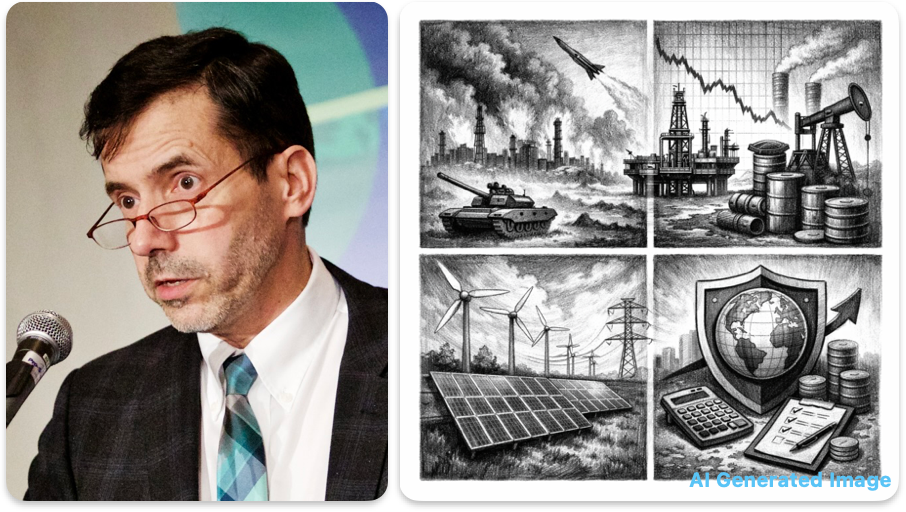
(LinkedIn: https://www.linkedin.com/pulse/could-iran-war-mark-peak-fossil-benoit-marcoux-9m6ge/)
Why this war matters beyond the Middle East
Two weeks into the Iran war, the immediate military and diplomatic stakes are obvious. But the most important long?term consequence may be a faster energy transition. The longer the crisis lasts, the more pressure there will be for a faster transition.
Oil and gas markets react instantly to geopolitical shocks. Tankers, pipelines and maritime choke points such as Hormuz make fossil fuels inherently exposed to conflict. Each crisis reminds governments and businesses of a simple reality: fuel?based energy systems depend on fragile global supply chains. This exposes countries to the political peril of being at the mercy of unpredictable or adventurous administrations in major exporting states or security alliances.
Electric systems based on solar, wind, batteries and, where available, hydro work differently. The equipment may be imported, but the energy itself is local. With the right industrial policies, much of this infrastructure can also be manufactured domestically. Fossil fuels, by contrast, depend on geology. They cannot be manufactured and must be extracted where the resource happens to exist.
Even when solar panels or battery cells are imported, they represent only part of the overall cost of the system. In solar and battery storage projects, a majority share of the investment lies in the balance of system, installation, grid connection and integration, which are local activities. Unlike fossil fuels, where much of the economic value leaves the country with every shipment of oil or gas, these projects generate a substantial share of their economic impact locally through engineering, construction and electrical infrastructure.
This distinction between fuel flows and energy infrastructure may prove decisive.
Signs the Fossil System May Be Nearing an Inflection Point
Recent developments suggest the global fossil system may already be closer to its structural peak than many assume.
Consider China, which has been the main engine of oil demand growth for two decades. A large share of recent “demand” has actually been stock building. Estimates suggest that roughly one million barrels per day of crude had been going into strategic reserves rather than final consumption before the Iran war.
At the same time, most remaining demand growth in China now comes from petrochemical feedstocks. Fuel demand itself appears to have largely plateaued, which reduces the exposure of China to the Iran war.
On the supply side, U.S. shale no longer looks like an endlessly expanding source of production. Output remains high, but growth has slowed significantly and several analysts see signs that the easy expansion phase may be nearing its limits.
Meanwhile, a different pattern is emerging in parts of Africa and South Asia. Where electricity grids are weak and imported fuels expensive, solar, batteries and electric two? and three?wheel vehicles are spreading quickly. These systems often prove cheaper and more resilient than fuel?based alternatives.
None of this means fossil fuels are about to disappear. Phasing them out will take time and the global economy will rely on them for years. But reducing exposure to their price volatility and geopolitical risk is increasingly becoming a sensible risk?management strategy for many countries.
The key moment in any industrial transition is when demand stops growing and begins a structural decline.
Once that point is reached, the dynamics of an industrial change. Investors become cautious about financing long?lived fossil projects. Electrified technologies continue to fall in cost as manufacturing scales. Each EV, heat pump or solar installation permanently removes part of fossil demand.
Industrial transitions thus often speed up after the peak.
What China and Europe Appear to Have Understood About Energy Security and Choke Points
China and several European countries already appear to be operating with this logic.
China has aggressively deployed solar, batteries and electric vehicles while building strategic oil reserves to manage short?term supply risk. At the same time, it has invested heavily across the supply chains for solar, batteries and critical minerals, seeking not only to power its own economy but also to control key choke points in the emerging global energy system.
Many European countries, after the shock of Russian gas dependency, are accelerating electrification and renewable deployment precisely to reduce exposure to fossil fuel geopolitics.
In both cases, the strategy is similar: manage near?term fossil dependence while reducing long?term exposure.
China’s growing petrochemical sector also values heavy crude streams as feedstock, a reminder that, even in a declining fuel market, some types of oil may retain strategic value as industrial carbon sources. This point is particularly relevant for countries such as Canada that produce heavy crude, including oil sands.
Implications for Canada and Québec
For countries such as Canada, and for Québec in particular, the implications are somewhat different.
Fossil fuels will remain part of the global energy system for years, and demand will not disappear overnight. Managing this transition therefore requires careful risk management.
Three principles matter in particular.
First, the declining fossil demand must be managed pragmatically during the transition. Abrupt disruption would be economically damaging.
Second, governments should be cautious about funding long?lived infrastructure that could become stranded if global fossil demand eventually declines. Public policy should avoid transferring that risk to taxpayers or electricity customers.
Third, accelerating electricity infrastructure carries relatively little downside in a world where electricity demand is already expected to grow. Electrification of transport, heating and industry will require major grid expansion and generation capacity in any case. Moving faster on electricity systems therefore reduces exposure to fossil volatility while supporting infrastructure that will be needed regardless of how quickly the transition unfolds.
In other words, the transition is not only about replacing energy sources. It is also about managing risk in a period of structural change.
From Energy Transition to Risk Management
Conflicts in the Gulf will not end the fossil era. But repeated geopolitical shocks can change expectations. Once markets begin behaving as if fossil demand has peaked, the system tends to move in one direction.
The deeper transition is not simply from fossil fuels to renewables.
It is from global fuels to local electricity.


