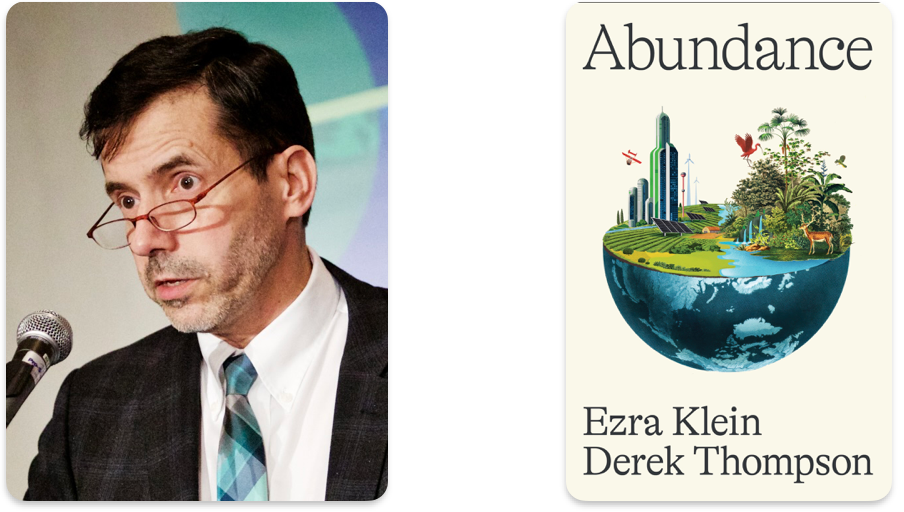
Ezra Klein and Derek Thompson’s Abundance is fundamentally a book about the United States. That matters.
It is written against the backdrop of a country that is increasingly dysfunctional, where institutions that once enabled large-scale execution are now contested, weakened, or actively dismantled. The authors are trying to explain how a system that once built the interstate highway network, the Apollo program, and the modern research ecosystem has lost its ability to deliver.
Canada, and Québec in particular, are not in that situation.
Our institutions are imperfect, but they are functioning. Public utilities work. Regulatory bodies operate. Governments retain a baseline level of legitimacy. Yet this does not automatically translate into ease of execution. In practice, it is often easier to build in places like Texas than in Québec. The apparent contradiction is real: functioning institutions can still produce slow outcomes when processes accumulate, mandates overlap, and decisions are sequenced rather than integrated. That difference should frame how we read the book.
And yet, many of the book’s core insights still apply.
The real constraint is no longer resources, but execution
The central argument of Abundance is that advanced economies are no longer constrained by a lack of ideas, capital, or technology. They are constrained by their ability to execute.
Scarcity today is often institutional.
Not because we cannot build, but because we do not.
This is visible in Canada through long project timelines, rising infrastructure costs, and cumulative regulatory friction. In energy, it shows up in delays in transmission, generation, and resource development. The issue is not engineering capability. It is coordination, sequencing, and decision-making.
State capacity, not state size
One of the book’s most useful clarifications is the distinction between state size and state capacity.
The question is not whether the government is large or small. It is whether it can achieve its objectives.
Québec already has a significant state presence, particularly in energy. Hydro Québec is a clear example of strong institutional capability. But even there, execution is becoming harder at the margin, and this may become a bottleneck for the energy transition.
The issue is not adding more policy. It is ensuring that existing institutions can deliver outcomes.
The green dilemma, Canadian version
One of the strongest sections of the book is the “Green Dilemma”: environmental frameworks designed to stop harmful projects are now also stopping beneficial ones.
This applies directly to Canada.
Regulatory regimes built to constrain polluting and oil and gas industries are now being applied, often with little adaptation, to renewable energy, transmission infrastructure, and critical mineral development. In Québec, the BAPE (Bureau d’audiences publiques sur l’environnement, or Public Hearings Office on the Environment) increasingly functions as a de facto project stopper, and could be referred to as a “Bureau d’arrêt des projets électriques.”
The result is counterproductive.
Projects that are essential to decarbonization face the same procedural burden as those they are meant to replace. This slows the energy transition and is not aligned with environmental objectives.
Institutional friction, Canadian reality
The Canadian issue is less about excessive lawyering, like in the US, and more about accumulated institutional friction.
Multiple layers of governance, overlapping mandates, and sequential approval processes create delays and uncertainty. This is compounded by the fact that energy is regulated independently in each province, with distinct frameworks, priorities, and approval processes.
The result is a fragmented system where projects that span jurisdictions, such as transmission or supply chains, face additional coordination challenges.
The effect is similar to what the book describes: longer timelines, higher costs, and reduced execution capacity. But the mechanism is different, and so are the solutions.
The missing dimension: industrial capacity
Where the book is weakest are supply chains and industrial capacity.
It largely assumes that once barriers are removed, projects can proceed.
That is increasingly false.
In energy and infrastructure, constraints now include equipment availability, skilled labour, and manufacturing capacity.
This is where Canada and Québec have a structural opportunity.
Unlike fossil fuels, which depend on geology, many components of the energy transition can be manufactured. With the right industrial policies, capacity can be built locally. This is a strategic lever that the book largely ignores.
What to take from Abundance
Abundance is a sharp diagnosis of a real problem: advanced economies have become less capable of building.
For Québec and Canada, the lesson is not to replicate the U.S. debate, but to act before we converge toward the same dysfunction.
The priorities are clear: focus on execution rather than additional planning, adapt regulatory frameworks to the realities of the energy transition, and build industrial capacity alongside infrastructure.
The risk is not that we lack ideas.
It is that we become progressively less able to turn them into reality.


